GymLogic ships Circuits: the round is the unit of work
· 9 min read
Tom Holland’s Spider-Man prep workout went viral for a reason: five pull-ups, ten push-ups, fifteen air squats, twenty minutes, as many rounds as you can. The score is not kilos. It is something like 27+3: twenty-seven full rounds and three pull-ups when the clock hits zero. Holland’s published mark sits at 27. GymLogic ships that beat as editorial copy on Cindy, not as a fake row in your personal-best list.
That workout is easy to screenshot. It is awkward to own inside an app that still thinks a day is a sorted list of independent exercises.
Why Circuits earn their place
Supersets and circuits are not a niche. They are a standard training primitive: the way you program a finisher, a conditioning block, a Freeletics-style pyramid, or a bodyweight WOD you can run without a rack. That last part is the point for anyone who trains on the street, in a living room, or against a friend’s score. No barbell required, and the shape travels.
The payoff is a comparable result. Once a Circuit has a stable identity and a mode-aware score, your 27+3 this Tuesday and your 27+3 next month are the same workout, so a personal best actually means something. Diamond on the Spidey track equals Holland’s 27 rounds (PR #485). A group challenge is just two people reading the same score off the same shape, not two screenshots you eyeball side by side.
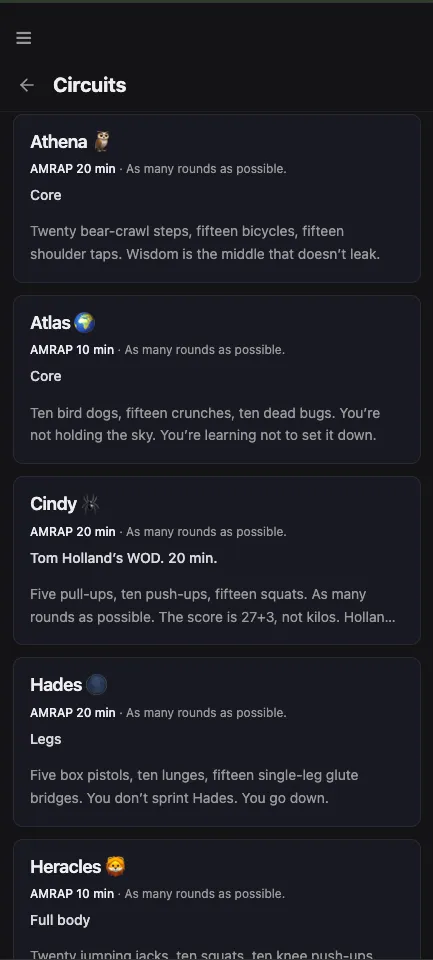
GymLogic ships Cindy plus a small Greek pantheon to make the point. Not eight random gods: a matrix of four specialties, each pairing one Olympien at AMRAP 20 with one Héros at AMRAP 10, so “I have ten minutes and I want legs” has an answer.
None of that works on a flat list. Here is what a flat list was, and what it cost us to leave it.
A day used to be a flat list
Before Circuits, a GymLogic workout_day was exactly that: workout_exercises ordered by sort_order, each row carrying one scalar prescription (sets, reps, weight, rest) in file:supabase/migrations/20240101000003_create_workout_exercises.sql. Session UI lit one exercise at a time. The rest timer was mono-stream. There was no group, no “between rounds,” no way to say the gap after the last station is rest and the gap A→B inside a loop is only a transition.
That model is fine for a classic PPL day. It lies the moment you want a superset, a Freeletics-style pyramid (20 → 15 → 10), or Holland’s cap.
Issue #351 was the user demand: stop pretending advanced programming is “two solos next to each other with a note.”
The near-miss we did not ship
The cheapest schema looked tempting. Option A: nullable group_id + group_position on workout_exercises, every member of the group sharing the same set count and a single reps value. Backward compatible. Fast. Wrong for the product we already wanted.
Pyramids need a different number per round. Transitions need a timer that is not “rest after every set.” A history card that flattens A and B back into disconnected solos makes the training look like something else happened. ADR 0007 records the call: ship the rich structure in v1, and keep the expensive brain (the progression engine) flat.
So we almost shipped a cosplay circuit. We would have remigrated the moment the first pyramid showed up.
Structure ships rich. Intelligence stays flat.
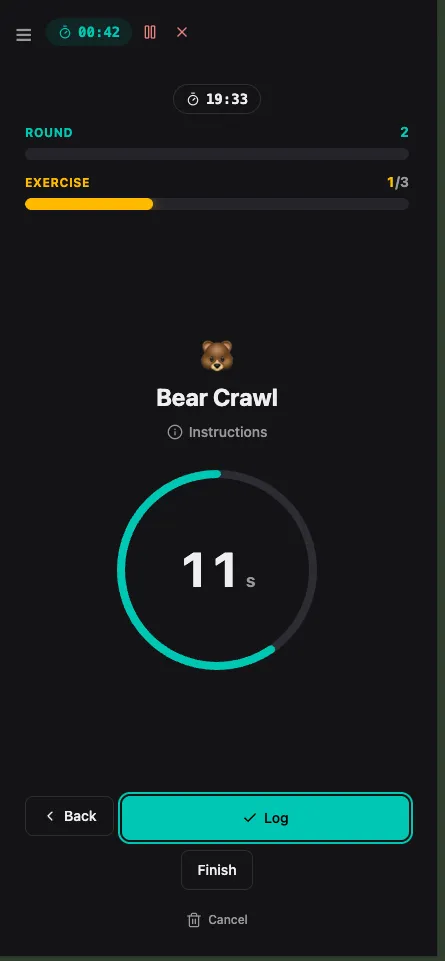
What landed is an Exercise Block: ordered stations, a round count, block-level rest between rounds, a Transition between stations inside a round, and a Per-round Prescription { amount, weight } per cell. In the UI you never see the word “block.” Lifters see Circuit. Code and tables still say exercise_blocks: ubiquitous language with a split we chose on purpose (ADR 0007 §5).
A workout day became a Unified Day Sequence: solos and Circuits interleaved on one sort_order. Heavy squat, then a finisher Circuit, then curls. Not a separate “circuits section.” Not “everything is a block.”
In session, Circuits do not reuse the auto-advancing single-exercise strip. They get a Round Screen: this round’s numbers, transition, then rest after the last station, then the next round’s grid.
What we deliberately did not do in that first wave: hang Circuits on the progression engine. No Progression Suggestion, no per-round Prescription Snapshot, no auto WEIGHT_UP inside a pyramid. Frozen prescription, hand-edited in the Builder. Logging still writes set_logs actuals. That is not laziness. It is the cost bound that made the rich model shippable without rewriting file:src/lib/progression.ts.
“A note in Strong is enough”
The honest objection: open any logging app, write “A1/A2 superset,” start a phone timer, done.
It is enough until the numbers change by round, until rest belongs between loops rather than after every movement, or until you care whether Tuesday’s Cindy and next month’s Cindy are the same workout. Free text does not fingerprint. It does not invert a score when the constraint flips from “N rounds, time is the result” to “20 minutes, rounds are the result.” It does not stop an agent from minting a fresh snowflake every time someone says “Cindy.”
We built the structure first. Then we closed the holes the flat list had papered over.
Closing the Cindy hole
#351 explicitly cut AMRAP and EMOM to keep v1 bounded. That left Holland’s WODs expressible as marketing, not as data. PR #475 added AMRAP as a termination mode on the same Circuit primitive: cap in minutes, wall-clock from GO, leftover stepper, score written 27+3 and always glossed (27 rounds · 3 push-ups). Tours Circuits keep time as the result. Same Round Screen family; inverted score. ADR 0014 persists a Block Run so kill-app mid-cap does not reset you to 20:00.
Expressible is not identity. A disposable Circuit with a “Cindy” label still keyed history on a throwaway block_id. PR #478 made Cindy a Benchmark Circuit: catalog row, frozen Rx, slug cindy, story and Holland reference shipped as copy. Dropping her snapshots Rx onto the day and stamps benchmark_circuit_id. Two Tuesdays compare. Edit the official recipe and you Circuit Fork (a private row) instead of poisoning the name.
PR #479 made that droppable in the Builder: Add Exercise gained an Exercises | Circuits kind. Circuits lists GymLogic seeds as WOD cards, not muscle pills. Search for holland from Exercises pins Cindy above the catalog. Create-circuit stays the jetable authoring verb.
One seed is a showcase. PR #481 seeded the eight Greek Benchmark Circuits from the shelf above beside Cindy. The label carries the emoji (Zeus ⚡) instead of a separate glyph column, and each seed ships a real bilingual story rather than a placeholder: “Five burpees, ten jump squats, fifteen push-ups. The king doesn’t weigh anything. He counts rounds. Twenty minutes under the storm.” Search accepts accented aliases too, so arès and thésée find their card. That copy sells the WOD without pretending we shipped a CrossFit leaderboard. PR #484 put an encyclopedia under Library at /library/circuits: browse story, Rx, and your catalog-keyed history. Browse is not drop; Meet Cindy remains the write path (ADR 0018).
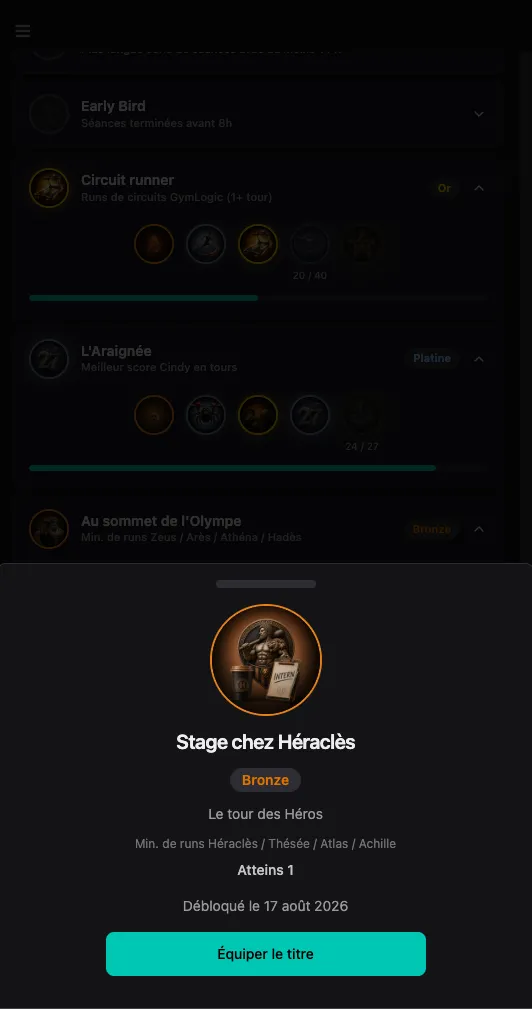
PR #485 finally feeds finishes into Succès: Circuit runner, Spidey (Cindy full-round PB ladder, diamond = Holland’s 27), cast-clearing tracks for Olympians / Heroes / Pantheoniste. Completing Zeus stops being invisible to achievements.
That sequence is not a feature dump for its own sake. It is what you can build once the unit of work is the round and the score knows how the Circuit ends. GymLogic’s catalog is still curated seeds, not a social board; the bet is that identity plus Round Screen plus history is the reusable core, and publish or ranked shelves can hang off that shape later without another remigration.
What I’d quote back
A session is not a flat list of independent exercises. Once you train supersets and circuits, the round is the unit of work, and prescription, timers, history, and score have to follow.
We almost faked that with a group_id. We shipped the rich Circuit instead, kept progression off it on purpose, then filled AMRAP, Cindy, a small pantheon, a Library shelf, and the Spidey track on top of a model that could hold them.
If you already train in GymLogic: open Library → Circuits, or Builder → Add Exercise → Circuits to drop one on a day. Cindy is waiting. If you want the gory ADRs, start at file:docs/adr/0007-exercise-blocks-rich-structure-no-progression.md and walk forward.